


Sable Cruiser, Phyllomacromia monoceros , Swartswalker
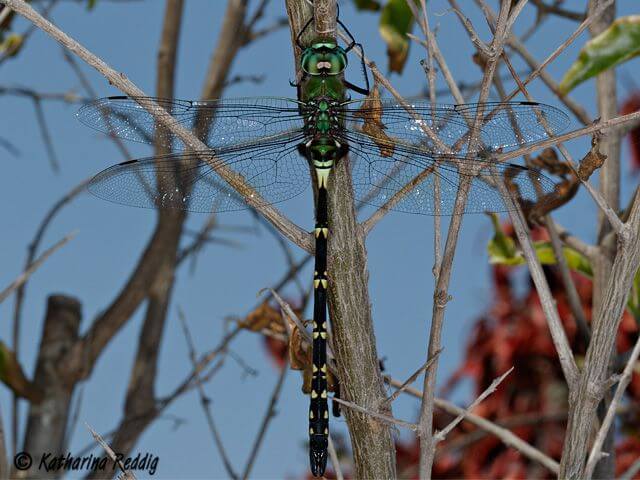
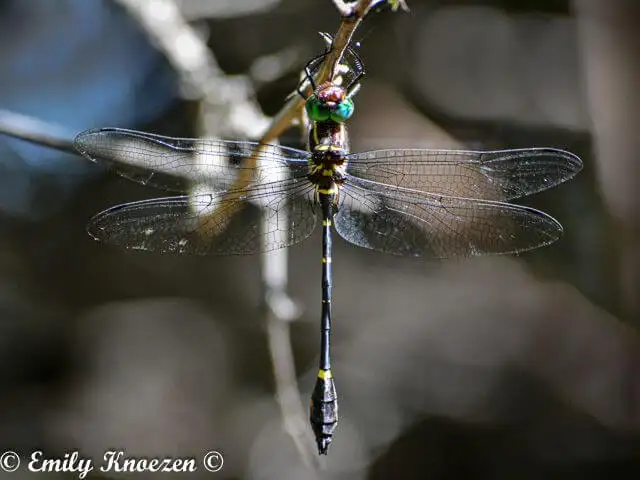 Male
Male
 Female
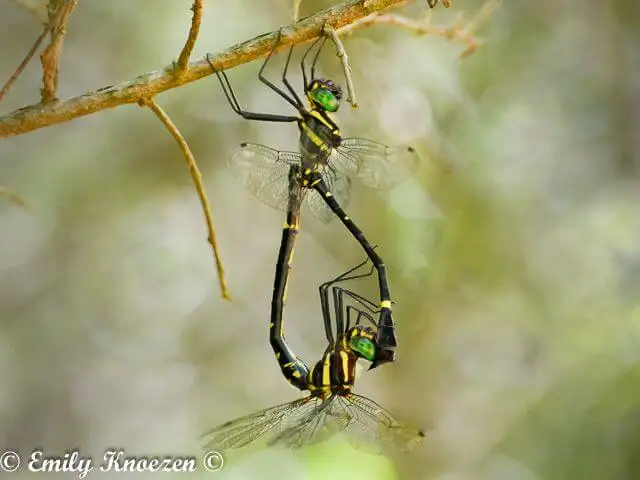 Pair
Pair
Short description:
Sable Cruiser, Phyllomacromia monoceros, Swartswalker is very large sized, with metallic black and yellow coloration with a pronounced clubtail and long vertical spine at the end of the abdomen (s 10).
Previously known or also known as the Unicorn Cruiser or Black Cruiser
Family Macromiidae (Needham, 1903)
More Images:
Click on all images to enlarge or view more
Key identification features:
Male: 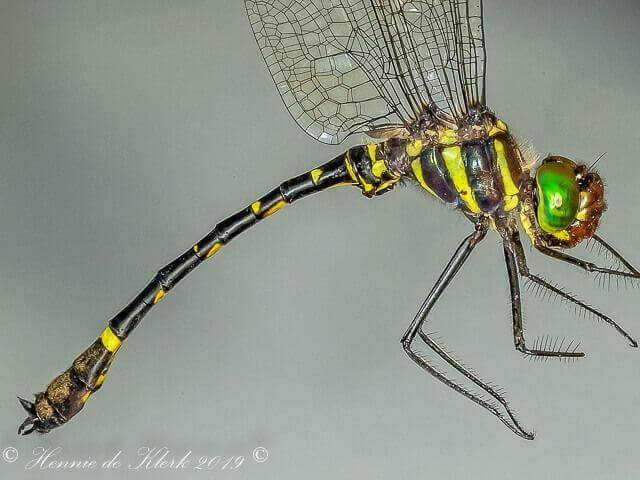
- Face is brownish to olive becoming yellow laterally. Frons is dark brown, slightly metallic with a diffuse, yellow spot on top. Vertex is metallic bluish-black.
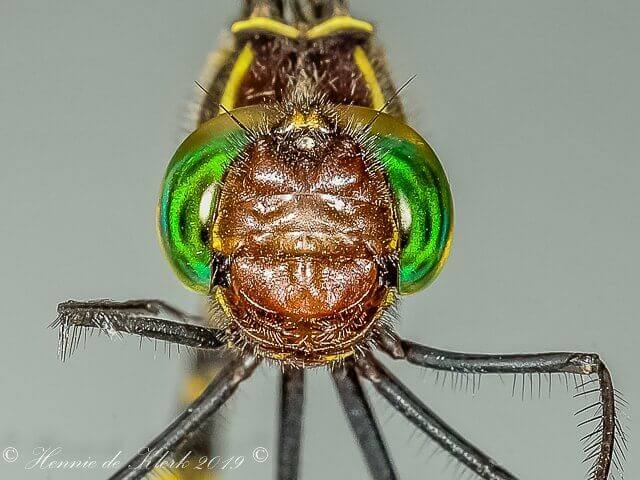
- Eyes are turquoise, bluish above, more greenish below.

- Thorax is dark brown and greenish yellow striped, with slight sheen on dark areas. Antehumeral stripe always complete
- Wings are clear to smoky. Hind wing 34-42 mm. Costa largely black, not contrasting with pterostigmas
- Abdomen is narrow with a club from s7-9. Largely dark brown to black with a small yellow saddle on s2, and small yellow spots. Black of genital lobe and dorsum s2 usually connected by black bar
 , although s5-6 almost completely black. First third of s7 with yellow ring. s8- 10, and superior appendages black
  . S9 with a backward-pointing spine, and s10 with a huge, conical, upright spine
  . S10 without tooth at base of peak
Female:
- Similar but much stouter and marginally larger.
- Club small
Habitat:
- Streams shaded by forest. Often with coarse detritus and a sandy, soft (like muddy) and/or probably gravelly bottom, and probably submerged roots.
- Inferred to occur from 0 to 2000 m above sea level.
Behaviour:
- Perches very conspicuously on tips of sedge or reeds in open water. Often seen cruising among treas in open clearings
Compared with other species:
- With Anax tristus, Black Emperor
 of the largest black and yellow dragonflies in RSA.
 - P. contumax Two-banded Cruiser,
 is easily recognised on the wing by the long, yellow saddle on S3 and more yellow at base of abdominal club.
 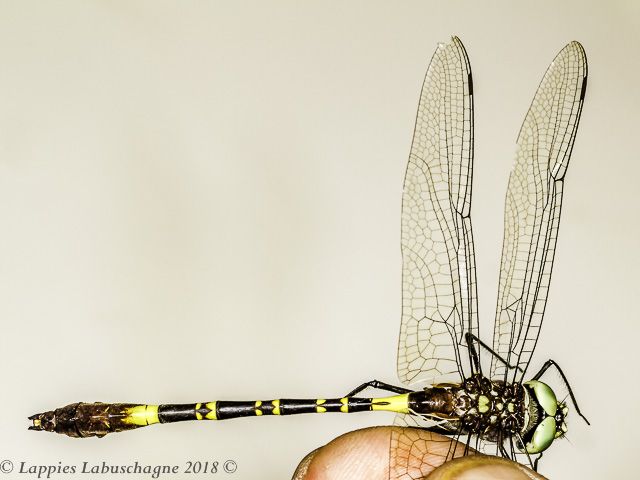 By S10 lacking the dorsal spine
  of P. picta and P. monoceros.
 P. contumax have no (or occasionally very small) stripes on side of thorax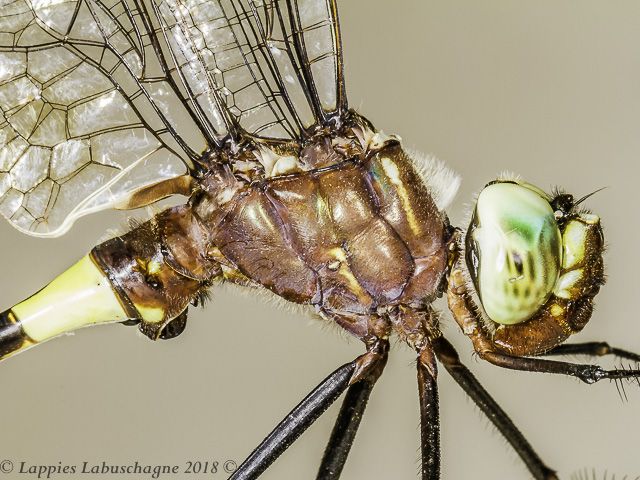
- P. picta (Darting Cruiser) have broader yellow abdominal bands

- P. monoceros (Sable Cruiser) is only marginally smaller than P. contumax, Two-banded Cruiser
- P. monoceros (Sable Cruiser) has almost no (if any very thin) abdominal bands
- P. picta (Darting Cruiser)
 is smaller than P. contumax, Two-banded Cruiser, and has a more erratic flight.
 - P. contumax, has a plain, dark brown thorax and no spine.

- P. picta (Darting Cruiser) has reddish brown pterostigmas

- P. picta (Darting Cruiser) much smaller than P. monoceros., Sable Cruiser.
- P. picta (Darting Cruiser) spine on S10 is smaller, more backward pointing and less conical than in P. monoceros., Sable Cruiser.
Distribution:
 Distribution Map
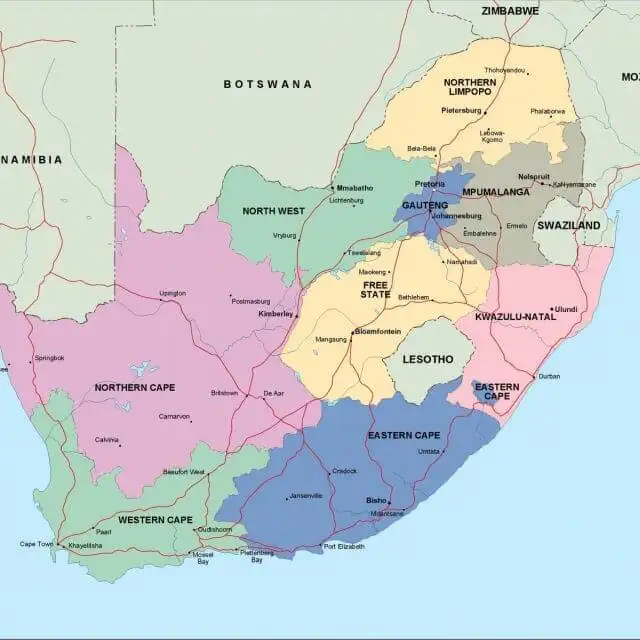 Political Map
 Topographical Map
 Distribution Map
 Political Map
 Topographical Map
South Africa:
- Very rare and localised in the north and north eastern escarpment mountains and adjacent hillsides of Limpopo- and Mpumalanga Provinces.
Africa:
- Democratic Republic of the Congo; Kenya; Malawi; Mozambique; Republic of South Africa; Tanzania; Zambia; Zimbabwe
Further reading:
Websites
 A Visual Guide to the Damselflies and Dragonflies of South Africa
 The IUCN Red Data List of Threatened Species Least Concern
Credit for description and comparison to Michael J Samways