


Gracious Wisp, Agriocnemis gratiosa, Grasieuse Soetjie
 Male
Male Male
Male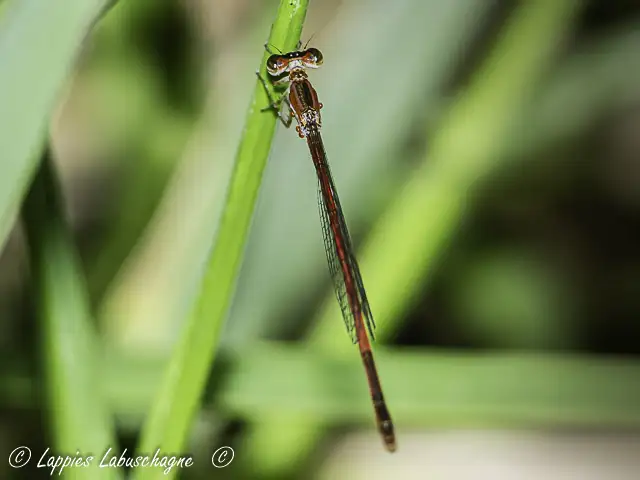 Female
Family Coenagrionidae (Kirby, 1890)
Short Description:
The Gracious Wisp is very small and mostly black with an orange abdomen tip
.More Images:
Image Gallery Male
MaleClick on all images to enlarge or view more
Key identification features:
Male:
- Face mostly black with light green moustache.Labrum highly metallic bluish purple with fine light green edge. Cheeks lime green. Anteclypeus greenish brown. Lower part of frons forms lime green moustache with wide black central stripe forming the stem of a ‘T’ with the shiny black postclypeus forming a cross bar. Postclypeus edged in lime green.
- Head dull black with a bluish green sheen and metallic bronze patches from above, back of head lime green. Postocular spots almost round, sharp-edged and bright bluish green.
- Eyes black above, lime green below. Neck black with wide green collar in front, fine lime green hind margin.
- Thorax shiny black with bright bluish green shoulder stripes, lower half lime green becoming buff below.
- Wings clear. Pterostigmas dark grey with indistinct fine pale borders.
- Abdomen segments 1 to 7 with metallic black band above, band peters out on segment 8. Sides of segments 1 and 2 and first part of segment 3 lime green, sides of rest of segment 3 to first half of segment 7 buff. Sides and top of last half of segment 7, segment 8 and all of segments 9 and 10 bright orange. Appendages dull orange with black tips.
Female:
- Female head mostly velvety dark greenish brown, with reddish brown stripe on top of thorax, sides of thorax bright lime green, labrum and postclypeus are shiny dark brown
Habitat:
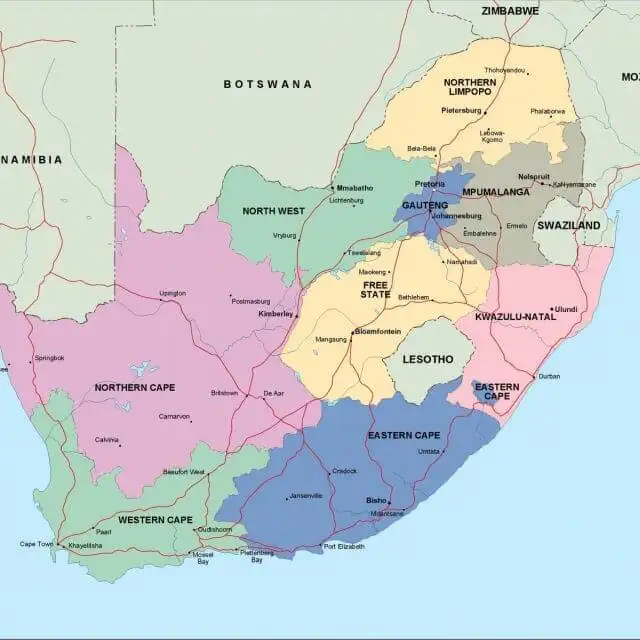
- The Gracious Wisp is highly localised in South Africa, only known from coastal northern KwaZulu-Natal. It occurs north to central Africa and also on Madagascar. It inhabits pools in coastal swamp or dune forest with canopy openings with tall grasses, ferns and herbs.
Behaviour:
- It cruises between sunflecks in thickly vegetated areas close to pools and rests with its abdomen in an oblique downward position.
- On the wingfrom December to March.
Compared with other species:
- White-masked Wisp, Agriocnemis falcifera is one of the largest Agriocnemis species in SA along with A. gratiosa Gracious Wisp
- A. falcifera pterostigmas with characteristically different colours in fore- and hind wing of the male
- A. falcifera has a very conspicuous pruinescent white moustache and elongated postocular spots
- A. ruberrima is easily recognised by its mostly all orange abdomen when seen from above.
- A.pinheyi, A. exilis (Little Wisp), and A. gratiosa (Gracious Wisp) are similar.
- A. pinheyi intermediate in size between the smaller A. exilis and the larger A. gratiosa.
- A. gratiosa and A. pinheyi has postocular spots intermediate in size between the smaller ones of A. exilis, and the larger ones of A. gratiosa.
- A. pinheyi has a fine, thorax shoulder stripe like A. exilis, but not the wider stripe of A. gratiosa
- A. pinheyi with unbroken light green moustache runs from eye to eye. Usually in A. exilis but always in A. gratiosa it is broken by a black division
- The dorsal, black, abdominal stripe of A. pinheyi tapers in S8 as it does in A. gratiosa and usually S7, but sometimes S8, in A. exilis.
- A. pinheyi appendages are distinctive with a downward-pointing horn on the inferior appendages ending in a small, slightly upturned hook. Diagnostic
Distribution
 Distribution Map
 Political Map
 Topographical Map
 Distribution Map
 Political Map
 Topographical Map
Africa
- It occurs north to central Africa and also on Madagascar.
- Botswana; Democratic Republic of the Congo; Kenya; Malawi; Mozambique; Namibia; Republic of South Africa; Rwanda; Sudan; Tanzania; Uganda; Zambia
South Africa:
- Highly localised in South Africa, only known from coastal northern KwaZulu-Natal. It occurs north to central Africa and also on Madagascar.
Further reading:
Websites of interest
 IUCN Red List of Threatened Species Least Concern
 A Visual Guide to the Damselflies and Dragonflies of South Africa
Credit Michael J. Samways & John P. Simaika. Manual of Freshwater Assessment for South Africa: Dragonfly Biotic Index