


Morphology of Odonata
General
Abbreviations and morphological synonyms
Synopsis
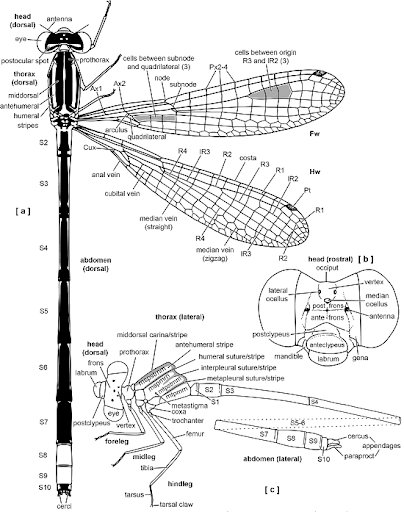
- For naming wing veins we adopt a simplified version of the much-used Tillyard-Fraser terminology, abbreviating only the medial and radial supplements (Mspl, Rspl), the multiple branches of the radius (R1-4; IR2-3) and the antenodal, cubital and postnodal cross-veins (Ax, Cux, Px).
- Ax, Cux, Px and abdominal segments are all numbered from the base, e.g. Ax2 is the second antenodal cross-vein from the base and S8-10 represents the eighth, ninth and tenth (thus the terminal three) abdominal segments.
Abreviations
- Abd: abdomen
- Antehumerals: antehumeral stripes
- Ax: antenodal cross-vein(s)
- Cerci = superior appendages
- Cux: cubital cross-vein(s) = Ac, anal crossing
- Epiproct = inferior appendage (Anisoptera)
- Fw: forewing(s)
- Hamule = posterior hamule (Macromiidae, Libellulidae)
- Humerals: humeral stripes
- Hw: hindwing(s)
- Paraprocts = inferior appendages (Zygoptera)
- Pt: pterostigma(s)
- Px: postnodal cross-vein(s)
- S: abdominal segment(s)
- Thorax = synthorax
Damselfly (Zygoptera)
Dragonfly (Anisoptera)
Wing vein nomenclature
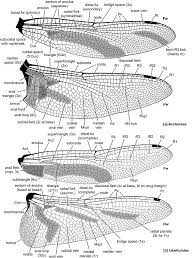
- The layout of the fore- (Fw) and hindwings (Hw) is similar.
- To indicate this and the degree of variation of various structures, we provided annotated pairs of wings from the two most disparate Anisopteran families.
- Annotations in brackets show how wing characters must be read, e.g. how many cells (c), cell-rows (r) or cross-veins (x) there are in a particular field.
- The part of the wing between the base and node is called ‘antenodal’, that between the node and pterostigma (Pt) ‘postnodal’.
- Most antenodal cross-veins (Ax) have a section anterior (‘costal’) and posterior (‘subcostal’) of the subcosta; postnodal cross-veins (Px) only have the costal sections.
Indicating relative positions
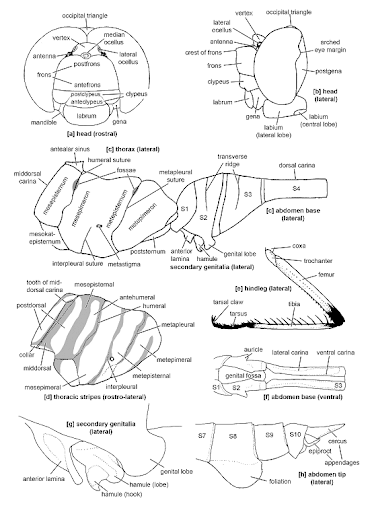
- Rostral, dorsal, lateral, ventral and caudal refer to views or positions on or towards the face, upperside (dorsum = back), sides, underside (venter = belly) and tail-end respectively.
- Anterior and posterior indicate relative positions towards the front end (head) and back end (abdomen) of the insect
- Proximal and distal refer to positions towards and away from the body, basal and apical to positions at the base or tip of a structure (e.g. segment or wing), and subbasal and subapical to positions near the base or tip.
- Medial is used for positions in-between extremes, e.g. roughly halfway between basal and apical.
Larvae
Damselfly (a Dragonfly (b)
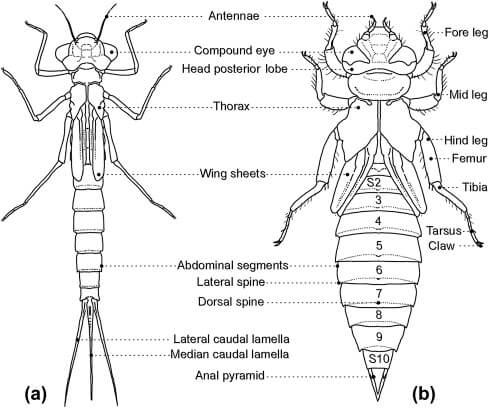
Credit African Dragonflies & Damselflies Online